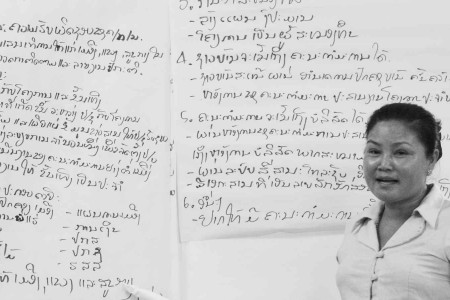
To consolidate best practices, research methods, and tools into a sourcebook on Water Smart Agriculture (WASA), experts recently gathered at a writeshop in Woliso, Ethiopia, Oct. 27-31st 2014.
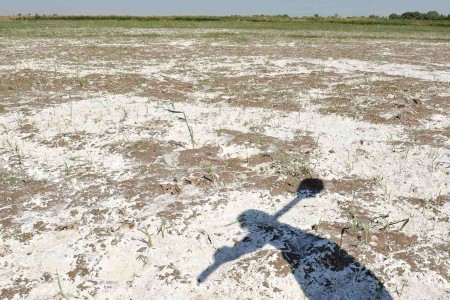
Around 5,000 acres of farmland in arid and semi-arid regions are lost every day to damage caused by salt, according to a UN report with contributions from scientists at the International Water Management Institute and WLE.
The International Water Management Institute launched a book summarizing a decade of research on irrigated urban and peri-urban vegetable production and safe wastewater reuse in Ghana.
Researchers hold a unique position in trying to address the challenges facing rural populations and natural resources in Africa. The situation is critical and exacerbated by climate change.
Two hundred researchers, extentionists, development practitioners and policy makers have gathered in Dhaka, Bangladesh to share research results, plans and ideas for unlocking the agriculture and aquaculture potential of the Ganges River basin’s coastal zone.
The International Water Management Institute has published 'On target for people and planet; setting and achieving water-related sustainable development goals' to help shape new policies and investments in the coming decades.
October 15 is the UN International Day of Rural Women. This day recognizes “the critical role and contribution of rural women, including indigenous women, in enhancing agricultural and rural development, improving food security and eradicating rural poverty.”
WLE is happy to announce that its 2013 Annual Report is now available. For WLE, 2013 was a year when the program refocused its work and began to articulate its ecosystem based approach.
The CGIAR Development Dialogues held in New York, aimed to link the role of agriculture in increasing food security, poverty alleviation, and improving health and nutrition to the United Nations Sustainable Development Goals.
The Water 4 Food project is one of five components being implemented as part of the International Fund for Agricultural Development and European Union-funded Water, Land and Ecosystems in Africa project (2014-2016).
Some of the world’s leading water, environment and resilience scientists and experts publish a call to the UN, saying that rain, and the way it is managed, is what will determine whether hunger and poverty can be eradicated in the world.