
Two hundred researchers, extentionists, development practitioners and policy makers have gathered in Dhaka, Bangladesh this week to share research results, plans and ideas for unlocking the agriculture and aquaculture potential of the Ganges River basin’s coastal zone.
The conference, entitled ‘Revitalizing the Ganges Coastal Zone: Turning Science into Policy and Practice’, is the final event of the CGIAR Challenge Program on Water and Food (CPWF)’s Ganges program. CPWF has worked on water management issues in the Ganges since 2003. For the past four years, the Program’s efforts have focused on finding ways to reduce poverty and improve social-ecological resilience in the coastal zone through improved water governance and management, and intensified and diversified agriculture and aquaculture systems.
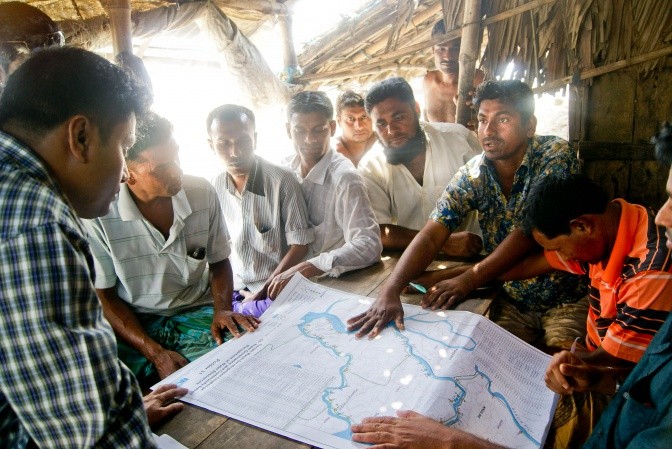
The focus of the conference is policies and implementation strategies for increasing the productivity of the coastal zone, and therefore contributing to the food security aspirations of the Government of Bangladesh. In addition to paper and poster presentations, the event has fostered cross-sector dialogue and discussions between Ministry officials, international donors and development programs, professors, and local government implementing agencies.
The water and land resources of the coastal zone have largely been misconceived as constraints to production and are therefore, under-utilized. CPWF research has demonstrated that in reality, they are rich and valuable resources, which can be used to support agricultural and aquacultural production and livelihood improvement of farming families and communities. With existing advances in crop and aquaculture technologies and current water resources, there is tremendous potential to improve food security and livelihoods. CPWF’s research indicates that what is required is improved coordination across the many stakeholders working and living in the region; delineation of the polders into smaller water management governance units based on shared interests and hydrological features; and a renewed focus on the importance of drainage, as opposed to irrigation, for food production.
While CPWF’s work in the Ganges concludes at the end of the year, WLE’s Ganges Region program will build upon portions of its work. WLE has received Expressions of Interest for its Ganges Focal Region and a writeshop will be held in Kathmandu in early November for the successful EOIs.
More Information
- About the conference
- CPWF Ganges River Basin Research Highlights
- Messages from the Ganges Basin Development Challenge: Unlocking the Production Potential of the Polders of the Coastal Zone of Bangladesh through Water Management Investment and Reform [PDF]
- Ganges Coastal Zone Issue Briefs [PDF]
- Summary of CPWF Research in the Ganges River Basin [PDF]
Other Partners
Collaborating partners: International Water Management Institute, International Rice Research Institute and the Institute of Water Modelling
Related contents

Blog Post 
Blog Post 


Related publications
Innovation in farm reward mechanisms is pivotal for transforming agriculture to protect and restore nature in the Global South
Commission on Sustainable Agriculture Intensification. 2021. Innovation in farm reward mechanisms is pivotal for transforming agriculture to protect and restore nature in the Global South. CoSAI Policy Brief 7. Colombo, Sri Lanka: Commission on Sustainable Agriculture IntensificationMining the gaps: Using machine learning to map 1.2 million agri-food publications from the Global South
Commission on Sustainable Agriculture Intensification. 2021. Mining the gaps: Using machine learning to map 1.2 million agri-food publications from the Global South. CoSAI Policy Brief 3. Colombo, Sri Lanka: Commission on Sustainable Agriculture IntensificationBetter instruments and approaches are needed to transform agri-food systems research and innovation
Commission on Sustainable Agriculture Intensification. 2021. Better instruments and approaches are needed to transform agri-food systems research and innovation. CoSAI Policy Brief 4. Colombo, Sri Lanka: Commission on Sustainable Agriculture IntensificationReorienting funding for research and innovation is an urgent step to transform agri-food systems
Commission on Sustainable Agriculture Intensification. 2021. Reorienting funding for research and innovation is an urgent step to transform agri-food systems. CoSAI Policy Brief 1. Colombo, Sri Lanka: Commission on Sustainable Agriculture Intensification
Controlled Environment Agriculture for sustainable development: A call for investment and innovation
Commission on Sustainable Agriculture Intensification. 2021. Controlled Environment Agriculture for sustainable development: A call for investment and innovation. CoSAI Policy Brief 9. Colombo, Sri Lanka: Commission on Sustainable Agriculture Intensification