Following the success of the IWMI led pilot of providing Index Based Flood Insurance (IBFI) in Bihar, India, the World Bank and the Government of India are interested in making IBFI available in flood prone regions. The project is supported by WLE and CCAFS.
Following the success of the IWMI led pilot of providing Index Based Flood Insurance (IBFI) in India, the World Bank and the Government of India are interested in making IBFI available in flood prone regions. The project is supported by WLE and CCAFS.
From Thomson Reuters, by Matthew McCartney, Chris Dickens, Luna Bharati and Alan Nicol. We need natural infrastructure - like forests, swamps, aquifers and grasslands - to overcome droughts and floods that have a high economic cost.
By April Thompson. The Symposium on Irrigation in African Smallholder Farming Systems, sponsored by the Feed the Future Innovation Lab for Small-Scale Irrigation (ILSSI), focused on increasing agricultural productivity with the help of irrigation and fertilizer so that Africa can meet its own growing food demand rather than rely on imports. The conference highlighted that irrigation can help communities adapt to climate change and other variability they are already experiencing, while also helping them face future uncertainty by building assets, all while acknowledging that the private sector is critical to irrigation scaling, and so are the public sector and development partners.
The Government of India announced a new multi-billion dollar scheme to solarize farm irrigation on a national scale. This is due to the success of the first ever solar pump irrigator's cooperative established in Gujarat, based on research done by the International Water Management Institute (IWMI), WLE and the CGIAR Research Program on Climate Change, Agriculture and Food Security (CCAFS), with support from the Tata Trust.
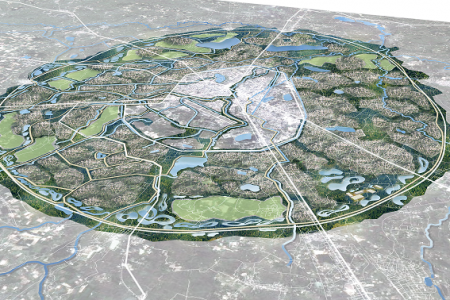
In an era of rampant land development and increasing climate unpredictability, the world is growing used to alarming images of flooded city streets. But cities can combat these floods by turning themselves into "sponge cities".
By Ignacio Ortinez of estudioOCA and Matthew McCartney and Priyanie Amerasinghe of the International Water Management Institute (IWMI). Urban floods cost billions of dollars per year and seem to be happening with increased frequency. "Sponge cities," which harness the absorbent power of wetlands can combat flooding and improve urban life.
At a Regional Workshop on Building Drought Resilience in Agriculture Partnerships and Outreach, held from 5-8 December 2017, experts from water and the climate agencies in the ASEAN region worked through strategies to help local agencies draw up drought preparedness and risk mitigation plans.
Shivchand Rai and Ram Badhan Rai, both smallholder farmers in Madhurpatti village, are confident of getting insurance for their damaged paddy crop, unlike in the past. This has been made possible by an initiative by International Water Management Institute (IWMI).
“I was insured for crop damage due to flood free of cost this year for the first time in my life,” said Shivchand, who owns 7.5 acres of farmland. Even a rich farmer like Bisambhar Prasad Yadav of Belaur village is looking forward to get benefit of the index-based flood insurance (IBFI).
MADHURPATTI, India, Oct 24 (Thomson Reuters Foundation) - When heavy rains swept through this village in northern Bihar in August and September, so much floodwater covered farmers' fields that it was difficult to tell one plot of land from another.
"After the flood, when we went out to see the land there was nothing there," said Babu Ram Rai, one Madhurpatti farmer.