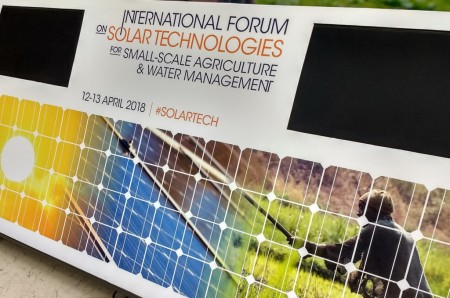
From project partners Future Pump. Solar irrigation has many benefits, both environmentally and socially, and while there is the potential to over extract groundwater, the private and public sectors should work together to make sustainable solar irrigation a reality.
The ability to organize research to create improved technologies and techniques in agriculture is one of the world's most important innovation processes. This website provides insights and tools on how to achieve this complicated task.
Coffee is a major export of Vietnam, but the highlands where about 40% of the coffee is grown, is experiencing water shortages in the dry season. Research has found that yields can be increased while decreasing water consumption, and irrigation practices can be improved.
Humans generate heaps of waste every day. Waste rich in energy, nutrients, or water. Most of it gets flushed down the drain, dumped in landfill sites, burned or even abandoned in public spaces or nature. Meanwhile, millions of farmers struggle with depleted soils and lack of water. A new 800-page book profiles multiple ways to harness this waste to help fill the world’s food and energy needs.
Dr Giriraj Amarnath and Dr Alok Sikka of International Water Management Institute (IWMI), explain how satellite images and flood modelling tools can help farmers in India.
Biodiversity – the essential variety of life forms on Earth – continues to decline in every region of the world, significantly reducing nature’s capacity to contribute to people’s well-being. This alarming trend endangers economies, livelihoods, food security and the quality of life of people everywhere, according to four landmark science reports released today by IPBES, written by more than 550 leading experts, from over 100 countries.
If asked where their water comes from, a local might point to Sundarijal or to the water tankers hurtling down Kathmandu’s roads carrying loads from distant springs and wells. But where does the water in Sundarijal come from? And how do these springs and wells stay filled with water all year round?
This World Water Day, the theme of which is ‘Nature for Water’, WorldFish and IWMI, key partners in the CGIAR FISH, reflect on how improved dam operation and reservoir management can mitigate the often negative impacts of large dams on natural fish stocks.
Four landmark regional assessment for the Intergovernmental Science-Policy Platform on Biodiversity and Ecosystem Services (IPBES) were launched yesterday at the IPBES plenary in Colombia. WLE researchers have contributed to three out of the four.
By Hua Xie and Claudia Ringler of IFPRI. The number of food-insecure people in Africa South of the Sahara remains unacceptably high and is set to increase as a result of climate change and weak agricultural and economic growth. According to the 2018 Global Food Policy Report, an additional 38 million people are projected to be at risk of hunger in 2050 as a result of climate change-induced slowdowns and disruptions in agriculture in the region—25 percent more than would be at risk in the absence of climate change.