Against a backdrop of worsening vulnerability to climate-related risks in India’s agriculture, the International Water Management Institute (IWMI) is launching a mobile app, called AgRISE, in support of a new national agricultural insurance scheme.
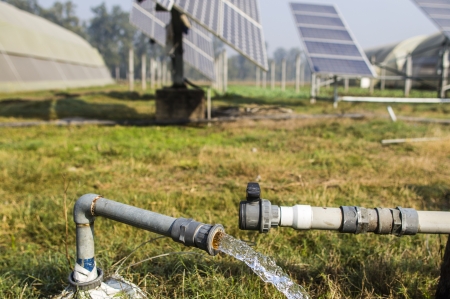
NDDB with assistance of the Rajasthan Electronics and Instruments Limited (REIL) and the International Water Management Institute (IWMI) have helped these farmers to create their own micro grid which enables them to sell the surplus solar energy produced in their fields to the state-owned power distribution company – the Madhya Gujarat Vij Company Limited (MGVCL).
“As PM will inaugurate our project, we will start selling surplus energy to the grid and become first grid connected farmers’ SPICE,” said Labhubhai Patel, secretary of the mandali which has started using solar energy since December last year.
NDDB with assistance of the Rajasthan Electronics and Instruments Limited (REIL) and the International Water Management Institute (IWMI) have helped these farmers to create their own micro grid which enables them to sell the surplus solar energy produced in their fields to the state-owned power distribution company – the Madhya Gujarat Vij Company Limited (MGVCL).
The collapse of a dam in southeastern Laos triggered massive flooding that killed dozens and displaced thousands of people, bringing a renewed focus on hydroelectric dams in mainland Southeast Asia. In an email interview, Diana Suhardiman, a senior researcher at the International Water Management Institute, discusses the trade-offs associated with large-scale dam projects.
A hydropower dam failure in Southern Laos has destroyed villages and left many homeless or dead. WLE and IWMI researchers are offering assistance to the flood relief efforts.
Advancing the agenda of land restoration in Africa’s Sahel region, let alone globally, is no small feat. But it is essential to underpinning fragile livelihoods and achieving the SDG’s.
Nature based infrastructure was at the forefront of this year's Stockholm World Water Week, and the Groundwater Solutions Initiative for Policy and Practice (GRIPP) special session looked at how we can harness the “green” infrastructure beneath our feet for improved water security and resilience for vulnerable communities.
In recent years, the mitigation of climate change and the improvement of soil fertility by sequestering carbon in the soil has become a hot research topic. The Swedish University of Agricultural Sciences and the International Center for Tropical Agriculture (CIAT), supported by WLE, have had great success in developing projects to provide individual farmers and extension officers with soil information of relevance for their management decisions, meeting an increasing need for spatial data on soil properties at multiple scales.
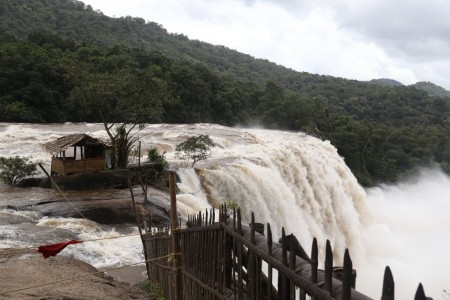
Across Asia, man-made structures have stood powerless to avert tragedy after tragedy during 2018’s rainy season. Dams are vital for energy needs and economic growth. But they’ve been criticised for posing risks to local communities and the fragile environments in which they are built. WLE and IWMI research proposes several innovative solutions that mitigate the threats of these fragile environments through natural infrastructure.
Inland fisheries are being overlooked in policy, management and development decisions, which is ultimately undermining the vital food and livelihood benefits they provide to the poor.
Severe flooding and drought caused by extreme weather patterns lead to about 10,000 deaths and US$40 billion in damage a year, with the number and extremity of the events is slated to increase in the future. The agricultural sector is particularly vulnerable.
Launched this year at Stockholm World Water Week, GRIPP has curated over 20 solutions for Groundwater-Based Natural Infrastructure, or GBNI, contributed from experts around the world. Groundwater is natural capital, and if managed properly, can provide resilience and water security in the face of future changes. Check out some case studies and learn more about the solutions on the new GRIPP platform.