Over the last 50 years, groundwater has played an increasingly crucial role in food production and livelihoods, especially in many parts of the developing world. It has boosted the socio-economic resilience of small-scale farmers and created new opportunities for food production in dry and drought-prone areas.
Too often, groundwater supplies are over-exploited, which can not only reduce food production but also negatively impact other ecosystem services such as the quantity and quality of drinking water.
To address the issues surrounding groundwater, ecosystems and the people dependent on them, WLE recently hosted a groundwater workshop at the International Water Management Institute (IWMI) headquarters in Sri Lanka. Participants representing a wide range of expertise and global perspectives gathered to share their research on ‘groundwater-dependent agrarian socio-ecologies’ (GDASEs).

The objectives of the conference were to:
Introduce the concept of ecosystem based services and a resilience based approach
Understand ecosystem services provided by groundwater
Analyze groundwater-irrigation case studies from around the world
Identify researchable tasks to improve policies
Explore innovative strategies to monitor the management of groundwater
Provide input to dissemination materials
A significant barrier is the lack of inter-disciplinary and inter-sectorial dialogues which are critical to ensuring healthy and resilient ecosystems. The divide between surface water and groundwater research, as well as the irrigation and drinking water sectors, are some such examples. The participants agreed that the role of science is to first identify ‘win-win opportunities’ and then generate knowledge for more informed decision making. This knowledge, together with community participation and the education of groundwater users, are critical components of the process towards more informed decision-making and a better understanding of trade-offs.
Buy-in from policymakers is also a significant challenge. Politicians are unlikely to act on recommendations that jeopardize their political capital; however, linking sustainable usage of natural resources with growing employment rates and livelihood benefits can motivate political action.
Thus, a combined approach that generates the evidence that can inform decision-making at various scales, from the community level to the political arena, is equally critical as is the enabling of a macro-policy environment, strong incentives and local and macro-level politics.
Several outputs or end products will also be developed following the workshop. This includes a framework document to help facilitate the practical application of GDASEs research. Participants will also develop action plans to incorporate the ecosystem based approach into their groundwater research and contribute input to the book Global advances in groundwater management and governance – incorporating the linkages for sustainable benefits.
During the workshop, participants also visited a farm in Kalpitiya, a coastal village in the Northwest, which managed to significantly expand agricultural production after investing in a sprinkler irrigation system using electrically pumped groundwater. Thus, it can be argued that the convergence of groundwater and ecosystem services are not necessarily conflicting perspectives.
There exists a significant opportunity to not only align these two areas with sustainable development but to also do so in a manner that involves a wider range of stakeholders, allowing for greater participation and thereby potential change.
Related contents
Blog Post 
Blog Post 


Related publications
Innovation in farm reward mechanisms is pivotal for transforming agriculture to protect and restore nature in the Global South
Commission on Sustainable Agriculture Intensification. 2021. Innovation in farm reward mechanisms is pivotal for transforming agriculture to protect and restore nature in the Global South. CoSAI Policy Brief 7. Colombo, Sri Lanka: Commission on Sustainable Agriculture IntensificationMining the gaps: Using machine learning to map 1.2 million agri-food publications from the Global South
Commission on Sustainable Agriculture Intensification. 2021. Mining the gaps: Using machine learning to map 1.2 million agri-food publications from the Global South. CoSAI Policy Brief 3. Colombo, Sri Lanka: Commission on Sustainable Agriculture IntensificationBetter instruments and approaches are needed to transform agri-food systems research and innovation
Commission on Sustainable Agriculture Intensification. 2021. Better instruments and approaches are needed to transform agri-food systems research and innovation. CoSAI Policy Brief 4. Colombo, Sri Lanka: Commission on Sustainable Agriculture IntensificationReorienting funding for research and innovation is an urgent step to transform agri-food systems
Commission on Sustainable Agriculture Intensification. 2021. Reorienting funding for research and innovation is an urgent step to transform agri-food systems. CoSAI Policy Brief 1. Colombo, Sri Lanka: Commission on Sustainable Agriculture Intensification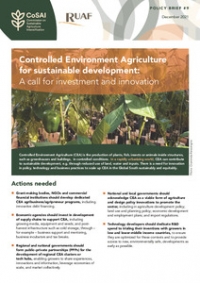
Controlled Environment Agriculture for sustainable development: A call for investment and innovation
Commission on Sustainable Agriculture Intensification. 2021. Controlled Environment Agriculture for sustainable development: A call for investment and innovation. CoSAI Policy Brief 9. Colombo, Sri Lanka: Commission on Sustainable Agriculture Intensification