The World Water Forum is one of the largest water related events; convened every three years, the 7th World Water Forum will take place from April 12-17, 2015 in Daegu, Korea. The exhibition will showcase a selection of technologies related to water management and bring together stakeholders from various arenas including research organizations, academia and the private sector.
The CGIAR Research Program on Water, Land and Ecosystems (WLE) led by the International Water Management Institute (IWMI), and partners, including the International Food Policy Research Institute (IFPRI) will be present at the event and participate in a variety of sessions. WLE, IWMI, the Global Water Initiative East Africa and CARE will also launch a sourcebook on Water-Smart Agriculture in East Africa at the 7th World Water Forum on April 14.
Find out more about IWMI’s presence at the 7th World Water Forum.
Featured Events
Launch event: April 14, 2015, 1.30 -2.30 p.m, B2F Dynasty Room of the Hotel Hyundai
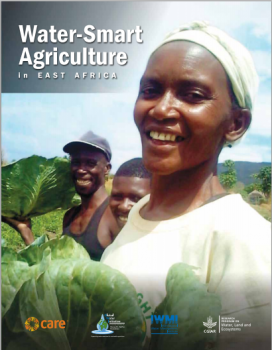
The Sourcebook on Water-Smart Agriculture in East Africa is a collection of case studies from soil conservation to building resilience, including farmers’ own innovative practices, that further develop this particular approach in East Africa aimed at a specific group of users- development managers, educators, local administrators and policy makers. These are the people who can utilize such practical research outputs, thereby enabling impact at scale at both local and national levels.
The Sourcebook on Water-Smart Agriculture in East Africa will be officially launched at the 7thWorld Water Forum in Gyeongu, Korea on April 14, 2015 from 1.30-2.30 p.m at the B2F Dynasty Room of the Hotel Hyundai.

Water-smart agriculture in East Africa
Technical event: April 14, 2015, 09:00-11:00, Room DEC-306

Resource recovery and reuse: inspiring change towards a circular economy
Participant: Javier Mateo-Sagasta (IWMI-WLE) (View presentation)
Humans generate millions of tons of wastewater and feacal sludge every day. Globally, much of this waste is discharged untreated to the environment leading to severe water pollution with deleterious effects on human health, ecosystems and economic activities. Fortunately, hopeful signs of viable solutions based on resource recovery from waste and safe reuse for beneficial purposes are already emerging around the globe.This session will then present some of these key success stories and will discuss how
these stories can be replicated at scale around the globe.
Side event: April 16, 2015, 11:20 am-13:20 pm Room DEC-304
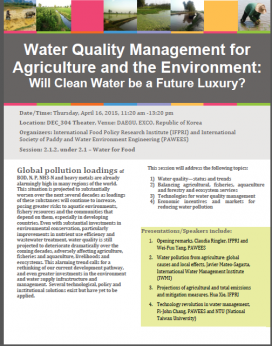
Water quality management for agriculture and the environment
Participants: Javier Mateo-Sagasta (IWMI-WLE), Claudia Ringler (IFPRI), Hua Xie (IFPRI)
Global pollution loadings of BOD, N, P, NH3-N and heavy metals are already alarmingly high in many regions of the world. This situation is projected to substantially worsen over the next several decades as loadings of these substances will continue to increase, posing greater risks to aquatic environments, fishery resources and the communities that depend on them, especially in developing countries.

Even with substantial investments in environmental conservation, particularly improvements in nutrient use efficiency and wastewater treatment, water quality is still projected to deteriorate dramatically over the coming decades, adversely affecting agriculture, fisheries and aquaculture, livelihoods and ecosystems.
This session will address the following topics:
1) Water quality—status and trends
2) Balancing agricultural, fisheries, aquaculture and forestry and ecosystem services
3) Technologies for water quality management
4) Economic incentives and markets for reducing water pollution
Concluding Thematic Session: “Water for Food”, April 17,11:20 – 13:20,DIB_B101, B1F Grand Ballroom A. Coordinated by the Food and Agriculture Organization of the United Nations (FAO)- a partner of WLE
Participants: Olcay Unver (FAO), Jeremy Bird (IWMI), Claudia Ringler (IFPRI), Tingju Zhu (IFPRI), Thiery Facon (FAO)
The concluding session of the theme of Water for Food will highlight the main findings from relevant sessions and outline of the next steps in addressing some of the key issues, keeping in mind that global food production will have to increase to satisfy a growing population. The session will provide a synthesis of the outcomes from a range of sessions, covering topics on water use-efficient technologies and the modernization of irrigation schemes, water quality management, adaptation to environmental change and farmers’ capacities in water use for agriculture.
IFPRI-WLE related events:

Water for food security and nutrition – A premiere of the Report of the High Level Panel of Experts on Food Security and Nutrition (HLPE) for the UN Committee on World Food Security (CFS); April 13,13:30 – 14:30; Venue : DEC_310 / DAEGU – EXCO / 3F Room 324; Daegu / Korea
Adapting to change for sustainable water use in agriculture; April 15, 9:00 – 11:00; DAEGU – EXCO, DEC_307, 3F Room 321
Making every drop count: Best available technology for water use in agriculture, April 16, 09.00 – 11.00, room DEC_307, DAEGU, EXCO Participant: Tingju Zhu (IFPRI)