Proper water management is a particularly tricky balancing act to achieve. There must be sufficient access to clean and safe water for consumption, sanitation, and agriculture, while communities must have enough disaster-risk infrastructure in place to deal with drought, flooding, and any other water-related issues. Too little and we have a problem, too much, and again, it’s a problem: this is a Goldilocks dilemma.
Manythong Siharath is worried. The wetland she depends on for her livelihood is changing and changing fast! In recent years, fishing has become a lot harder and her income has dropped significantly. She like many others around the world faces a shrinking wetland while her problems only continue to grow.
Ecosystem services is a term that does not translate easily into different languages, making it difficult to explain across cultures and contexts. The challenge becomes even more daunting when we want to understand how local communities use, perceive and value different ecosystem services: how can we collect views from others on a concept that is described by an amalgam of financial, conservation, regulatory and scientific parlance?
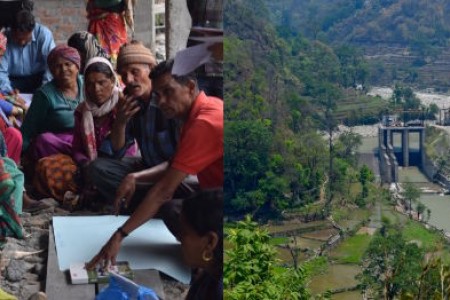
In Uttarakhand, as many as 450 new hydropower facilities are being developed rapidly and haphazardly. Installation of hydropower facilities presents a complex combination of benefits and risks for local residents. While providing local electricity, flood control and water storage for climate mitigation, there are also negative impacts.
Floods. It seems no matter where you turn these days, you can’t escape news of flooding in some part of the world. In the face of climate change and COP21, towns and cities all over the world must look to develop sustainably. Here's a look at green infrastructure issues in the Mekong.
The government of Tigray, a region home to a growing population of over 4.5 million farmers, continues to promote food security through improved production and expanding land use for agriculture.
This film follows a group of ten youth innovators as they devise a solution to landscapes challenges to be pitched to a panel of judges in a Dragon's Den style event at the Global Landscapes Forum.
In an unused school classroom in the village of Sekoti, Ghana, community members gathered to learn how to make a video. Many of them had never even used a camera before, much less operated a microphone. Participatory video is an empowering and creative process that allows those who understand their local issues best to have a voice.
Here’s a spin on what caught our eye this month. From the TEEBAgFood interim report released at the Global Landscapes Forum in Paris to the Indonesian peat fires to microbes and ecosystem service bundles. Read on!
In October, by good fortune, two WLE projects met in the polders of Bangladesh. Improved water management in the polders goes hand in hand with a higher value cropping system, observes van Steenbergen and Mondal.
Most people working in sustainable development are familiar with the ‘tragedy of the commons’ referring to when a group of individuals, all acting independently to deplete common resources, in this case degrading landscapes. But what if someone told you that the real tragedy was that these land has to be either taken over by the state or privatized in order to be sustainable?



/index.jpg?itok=kRH1fz96)