
The keystone of corporate sustainability is the business model where companies or groups of companies re-purpose their waste for a monetary and social benefit. At Stockholm World Water Week, Miriam Otoo from the Resource, Recovery and Reuse team at the International Water Management Institute gave a presentation demonstrating how to use partnerships to reproduce successful business models. The session was co-convened by WLE, WBCSD, CEWAS and RUAF.
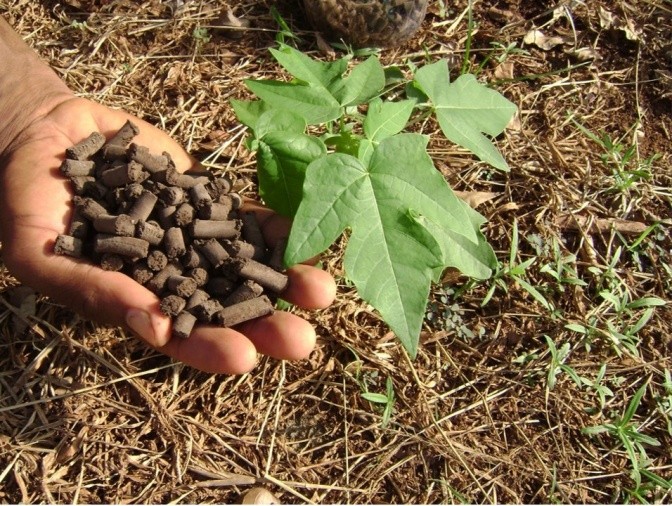 Fortified excreta pellets being applied as fertilizer to crops
Recovering water, nutrients, energy and organic matter from otherwise wasted resources provides an opportunity for closed-loop business models to both generate revenue and make valuable resources available for use, for example in agriculture. The Resource, Recovery and Reuse research team is developing a number of business models based on existing RRR cases across the developing world.
In an ideal case, a company can create a profitable resource recovery and reuse (RRR) subsidiary. Investing time and company resources into reproducing a successful RRR program demonstrates that a company is committed to the longevity of its sustainability and social stewardship programs. There are, for example, wastewater treatment plants generating energy to meet their own needs from their own waste resources. In many other cases, partnerships are required where one company transforms the waste of another into a marketable product.
The session in Stockholm discussed the advantages of smart partnerships and concluded with some important lessons for scaling up:
1. No one-size-fits-all
For global businesses, resource reuse subsidiaries will not follow a one-size-fits-all procedure; rather each program must be tailored to its local environment. Even with a profitable RRR program under its belt, a company will still face challenges when trying to enter a new market.
The RRR business model that works in Bangladesh, for instance, will not necessarily be viable in Chad. Consumers will have different health and resource access needs, different cultural biases and social norms, and different relationships with their local governments.
Therefore any initiative that interacts with social and environmental factors must be able to function in its unique context. These changes run from the superficial, such as re-branding the product and changing the marketing strategy, to the comprehensive, like re-designing existing technology to fit the needs of the environment.
To address this diversity, the WLE RRR program carries out comprehensive feasibility studies in different cities to explore how far the identified business models could work and also at which scale.
2. Financial Partnerships
Given the scale of the necessary program modifications, a company needs to create partnerships to secure funds and mobilize resources. Research and development efforts, prototypes and pilots, creating infrastructure, securing land, consulting with lawyers, make the initial phases of expanding RRR programs very capital-intensive.
Securing funding through partnerships with international and local financial institutions is mutually beneficial. A company can leverage the low investment risk associated with a proven successful RRR model to receive larger amounts of funding. In turn, the company will benefit from working with financial institutions that can give advice about budget allocations and culturally appropriate pro-poor financing models.
3. Partnering with Market Insiders
Understanding the nuanced cultural, political and socio-economic climates of the desired market is vital to the success of the RRR program. Hiring private marketing firms to do research on supply and demand is an excellent first step, but partnering with local community organizations, agricultural production associations, and non-profits will provide information that is crucial to optimizing market penetration.
A company needs to form partnerships with local farmers, turning the farmers into community ambassadors that can attest to the value of the product and the economic benefits of the service. A company should also identify local distributors and invest in them. Without distribution partners who know the market, the RRR program will never thrive.
4. Commitment to sustainable business
While an important goal of any RRR program is to increase profit, a company needs to also keep in mind its commitment to improve community health, social welfare and environmental conditions. The market research needs to answer these pertinent questions:
| Supply & Demand |
|
| Social Factors |
|
| Business Model |
|
| Environmental Factors |
|
5. Regulatory Partnerships
Learning the regulatory landscape is crucial to cutting costs and securing a future for the new RRR program location. Market entry will be considerably easier if the RRR program can take advantage of tax incentives, subsidies, and simplified clearance processes for business and product licensing. It is important for the RRR program leaders to develop trust-based relationships with policy makers, in order to eventually be in a position to influence local policy to improve the sanitation service chain and thus public health. A company might not enter into an enabling political environment, but it can help to create that environment. This might be important, for example, where partnerships cross from the formal to the informal sector, like in the new WBCSD program on improved WASH services in slums.
The expert panel in the Innovate Partnerships session implored that anyone attempting to create, or recreate, success in a RRR program use better judgment. The point of reuse programs and businesses is to improve environmental and social conditions while bringing in social and/or monetary revenue. But the program will not be successful in any of those endeavors without the proper research and partnerships.
For more information:
Please follow this link: Resource Recovery and Reuse at WLE to access the RRR Business Flyer and RRR Business Plan.
Related contents
Blog Post 
Blog Post /index.jpg?itok=EzuBHOXY&c=feafd7f5ab7d60c363652d23929d0aee "Making the energy transition to net zero through accelerating rural energy access")
Blog Post 
Blog Post