
In the West Bank and Gaza Strip, water scarcity adds pressure to a region already facing immense challenges. Not only is water scarcity driven by natural hazards but it is also a product of international agreements and of current permit regimes that constrain the construction and rehabilitation of wells.
As water is an integral component of the agriculture sector, its availability is a prerequisite for building sustainable and resilient livelihoods.
 A farmer tends to his irrigation system in the Khan Yunis governorate of the Gaza Strip. Photo: ©FAO/Marco Longari
The West Bank is in a drought-prone region. Lack of available water year-round threatens the livelihoods of thousands of families dependent upon agriculture for their livelihoods. Rain-fed crops and livestock, an indispensable source for the income and food security for many, have been especially affected by these challenges.
According to a comprehensive World Bank report on the Palestinian water sector, the Oslo Accords and their related administration regime were identified as the principle causes of water scarcity in the West Bank and Gaza Strip. In 1995, the Oslo II Accords (an interim peace agreement) divided the West Bank and Gaza Strip into three administrative areas (A, B and C), with varying levels of security and civil responsibility granted to either the Israeli or Palestinian authorities. Area C, which composes roughly 61% of the West Bank, is under both Israeli civil and military control, leaving Palestinians living there subjected to a restrictive zoning and building regime, greatly impacting their access to water.
Today, farming and herding communities here are especially affected by these policies, as without a connection to the formal water network they are largely dependent upon expensive water transported on tanker trucks for their use.
Under these conditions, challenges are substantial. But the Food and Agriculture Organization of the United Nations (FAO) has identified the “low hanging fruit” that can improve the accessibility and management of water resources to enhance agricultural development.
In partnership with the Ministry of Agriculture and the Palestinian Water Authority, FAO has undertaken various interventions, which include:
- increasing water harvesting and storage capacities at the community and household levels;
- ground water well rehabilitation; unit construction;
- provision of technical support to improve water supply and management;
- support to policy development and coordination across the agriculture sector.
These efforts have resulted in a significant amount of water and money saved.
Facilitating climate-smart agriculture through rainwater harvesting activities
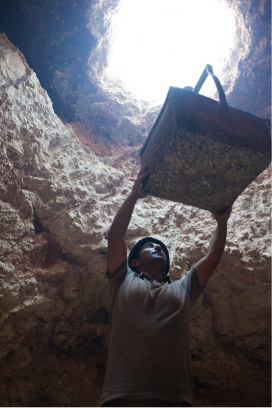 Labourers excavate a cistern in the Tubas governorate of the West Bank. Photo: ©FAO/Marco Longari
Conservative estimates show that for every USD 1 invested in household cistern construction, at least USD 17.5 worth of water is saved. FAO is working in several vulnerable areas in the West Bank that have especially limited access to water networks and suffer from reoccurring periods of drought. By enabling thousands of families to construct their own cisterns, Palestinians are now able to meet their water needs for both domestic and agricultural purposes.
With a reliable and cost-effective water source, beneficiaries are able to establish backyard gardens, which provide fresh produce either for their own consumption or to be sold at market. The cisterns also increase water storage capacity, allowing households to buy water in greater quantities and at significantly cheaper prices per cubic metre than buying water from tanker trucks.
Most herder communities – particularly in the eastern and southern parts of the West Bank – are in areas that can be difficult for tanker trucks to reach. Not surprisingly, many of these communities already have cisterns that are shared by several families, but have not been properly maintained due to access restrictions and declining standards of living.
This lack of maintenance has caused many cisterns to degrade, making access to water a recurrent and serious issue. Therefore, FAO invested in the rehabilitation of rainwater cisterns to improve access to water at the community level. The large storage capacity and subsequently cheaper access to water strongly lowers households’ water costs, thus increasing their resilience in these highly vulnerable areas.
To give you an idea of just how economically practical this intervention is, according to FAO estimates, for every USD 1 invested in community cisterns, USD 77 is saved in water costs. Since the actual structures are already in place and only need repairing, rehabilitation of community rainwater cisterns is one of FAO’s most cost-effective activities targeting water resource development.
Cistern construction and rehabilitation has created a reliable source of water, saving farmers a significant amount of money. Communities are now less dependant upon social safety nets and have greater access to food.
Related contents
Blog Post 
Blog Post 


Related publications
Controlled Environment Agriculture for sustainable development: A call for investment and innovation
Commission on Sustainable Agriculture Intensification. 2021. Controlled Environment Agriculture for sustainable development: A call for investment and innovation. CoSAI Policy Brief 9. Colombo, Sri Lanka: Commission on Sustainable Agriculture Intensification
Learning from agri-food innovation pathways in Brazil, India and Kenya
Commission on Sustainable Agriculture Intensification. 2021. Learning from agri-food innovation pathways in Brazil, India and Kenya. CoSAI Policy Brief 5. Colombo, Sri Lanka: Commission on Sustainable Agriculture Intensification
Eight research and innovation principles for sustainable and equitable agri-food system
Commission on Sustainable Agriculture Intensification. 2021. Eight research and innovation principles for sustainable and equitable agri-food systems. CoSAI Policy Brief 6. Colombo, Sri Lanka: Commission on Sustainable Agriculture IntensificationClosing a modest investment gap will put hunger, climate and water action back on track to meet global goals
Commission on Sustainable Agriculture Intensification. 2021. Closing a modest investment gap will put hunger, climate and water action back on track to meet global goals. CoSAI Policy Brief 2. Colombo, Sri Lanka: Commission on Sustainable Agriculture IntensificationPriority investments for innovation in urban and peri-urban agriculture (UPA) and food systems in the Global South
Commission on Sustainable Agriculture Intensification. 2021. Priority investments for innovation in urban and peri-urban agriculture (UPA) and food systems in the Global South. CoSAI Policy Brief 8. Colombo, Sri Lanka: Commission on Sustainable Agriculture Intensification
Comments
Thanks Cyril for this very nice example of low hanging fruits to lift people out of poverty. Your story once more confirms CPWF's key message that "water is not scarce, it's the way we manage it", even in the Middle East, although it is often taken as an example of water scarcity. It also confirms that in this region any source of water at household level becomes a resource for domestic and agricultural purposes - i.e. water systems tend to naturally become multiple use systems.
However the values you give in terms of water savings per USD invested do not say anything in terms of livelihoods for those households, and in turn of their capacity to invest themselves. Are there economic figures available from your study?
always top ... I love your super nice blog :)