
Technology has long been recognised as crucial to meeting the challenge of feeding a growing global population, but we are increasingly aware of technology’s risks, including environmental costs. Working with fellow ecologists and Friends of the Earth’s Big Ideas project, I have been exploring the way in which natural systems function as living organisms. How we might best use this understanding when it comes to producing food? And what role could technology play?
 In addressing food security, the place for technology is in mixed-use mosaic management; and its place is in the hands of farmers and fisherfolk, not global oligopolies. Photo: NASA Earth Observatory/Jesse Allen
Ecosystems are complex and provide multiple functions such as flood management, carbon storage and nutrient cycling. One of the problems with intensive agricultural production is that it destroys some of the processes that contribute to this complexity and diminishes many of the services that ecosystems provide.
Mosaic approaches to farming - where intensive but diverse areas of production are supported by and integrated with neighbouring areas providing waste retention, nutrient cycling, climate regulation and other services - enable ecosystem complexity and multi-functionality to be maintained, as well as increased yields of food.
My fellow author, Jules Pretty has identified how careful agro-ecological approaches can boost yields and sustain other ecosystem services. My own work on the management of mangrove forests shows how mosaic approaches can increase yields from fisheries, and enhance other services.
We argue that a mixed-use mosaic approach is likely to be more resilient than high-input monoculture approaches (maximum input intensification), but also more productive than a low-input extensification approach (such as many organic approaches). We argue that it will avoid the boom and busts in food production that will result from both monoculture and extensification approaches.
But this mixed-use mosaic approach requires a change in how we use technology.
Currently much of agricultural technology is focused towards monoculture. We need technology that works well for mixed-use mosaic agriculture. This will require drawing on the vast wealth of farming knowledge in different parts of the world, learning what works and what doesn’t. We think that the best way to do this is by using an open source approach to technological development.
Technology offers great opportunities – and its benefits are increasingly being felt in some of the remotest parts of the developing world. Plant genetics provides us with key insights into what makes crops resilient to changes in climate; digital technology has improved weather forecasting for very rural communities; advances in food storage technology can significantly reduce wastage. And mobile phones are already assisting farmers with market access. But it is important to recognise that the contribution technology makes will be limited, without greater access, and greater democratic input and control.
CGIAR’s origins are in fact a great example of how the free exchange of plant materials and access to field-based training for scientists helped overcome the challenges of food security in the 1970s and 1980s.
Open source access to technology is already re-shaping the dynamics of development in other fields. Open source software has unleashed enormous creativity in the field of computing, leading to vast data-sharing projects and greater collaboration. In medicine similar moves could lead to progress in treatments for malaria and TB.
In agriculture, seed sharing schemes enable farmers to protect varieties that are have adapted to local conditions, providing higher yields than proprietary versions. Some have suggested the need for a biological open source framework that will facilitate farmer ownership of seed sovereignty.
There is much to be gained from such approaches – and governments and philanthropists could help by supporting such schemes. Treating nature as a machine will lead to booms and busts in food production – but working with nature, and with each other, promises rich opportunities for increasing yields.
Former US President Benjamin Franklin said ‘a place for everything, everything in its place’. In addressing food security the place for technology is, in our view, in mixed-use mosaic management, and its place is in the hands of farmers and fisherfolk, not the control of global oligopolies.
Related contents
Blog Post 
Blog Post 
Blog Post 
Blog Post 


Related publications
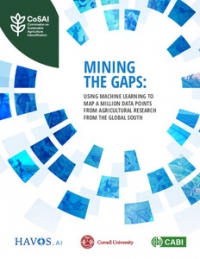
Mining the gaps:using machine learning to map a million data points from agricultural research from the global south
Porciello, J.; Lipper, L.; Bourne, T.; Ivanina, M.; Lin, S.; Langleben, S. 2021. Mining the gaps:using machine learning to map a million data points from agricultural research from the global south. Colombo, Sri Lanka: CGIAR Research Program on Water, Land and Ecosystems (WLE). 22p.
How can economic incentives designed for environmental conservation support a transition to sustainable and equitable agriculture?
Moros, L.; Puerto, S.; Monroy, D.; Achaval-Torre, J.; Rueda, X. 2022. How can economic incentives designed for environmental conservation support a transition to sustainable and equitable agriculture? Colombo, Sri Lanka: Commission on Sustainable Agriculture Intensification. 42p.
Annual report 2021: CGIAR Research Program on Water, Land and Ecosystems
CGIAR Research Program on Water, Land and Ecosystems (WLE). 2022. CGIAR Research Program on Water, Land and Ecosystems 2021 Annual Report: Connected Thinking, Compelling Solutions. Colombo, Sri Lanka: CGIAR Research Program on Water, Land and Ecosystems (WLE). 79p.Integrated rice and fish systems
Dubois, M.; Akester, M.; Ou, P.; Freed, S.; Leemans, K.; Mam, K.; de Silva, Sanjiv; Smith, B.; Teoh, S.J.; Aung, H.M.; Beveridge, M.C.M.; Marwaha, N.; Phillips, M. 2021. Integrated rice and fish systems. Penang, Malaysia: CGIAR Research Program on Fish Agri-Food Systems.Program Brief: FISH-2021-14
Unlocking the potential of flood farming to reduce flood risks and boost dryland production in Ethiopia
Desta, Gizaw; Legesse, Gizachew; Amede, Tilahun; van F.Rooyen, Andre; Whitbread, Anthony. 2021. Unlocking the potential of flood farming to reduce flood risks and boost dryland production in Ethiopia. Colombo, Sri Lanka: CGIAR Research Program on Water, Land and Ecosystems (WLE). 10p.
Comments
"We argue that a mixed-use mosaic approach is likely to be more resilient than high-input monoculture approaches (maximum input intensification), but also more productive than a low-input extensification approach (such as many organic approaches). We argue that it will avoid the boom and busts in food production that will result from both monoculture and extensification approaches."
This is a very interesting concept, I would love to read more about it. Where is it published?