|
Pesticide
Use and Abuse in Irrigated Areas
Pesticides
are used widely to control insects, weeds and fungi, that might
otherwise destroy a large part of the world's food crops. They are
also used in many countries to control insect vectors of human diseases
such as malaria.
It
has been estimated that at least three million cases of pesticide
poisoning occur worldwide each year, with 220,000 deaths. The majority
of these poisonings occur in developing countries where less protection
against exposure is applied, knowledge of health risks and safe
use is limited and harmful pesticides are easily accessible. Despite
the magnitude of the problem of pesticide poisoning, there have
been very few analytical studies in developing countries to identify
the risk factors.
The
dangers of pesticide use to human health can be summarized as:
- Acute poisoning
caused by intentional, occupational or accidental exposure
- Adverse health
effects caused by long-term (mainly occupational) exposure
In
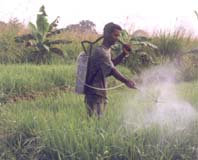
Sri Lanka, pesticide poisoning is often identified by farmers and
health workers as the primary health concern in irrigated areas.
The high use of pesticides in irrigation schemes makes the study
of pesticide-related health problems especially relevant to irrigation
communities.
IWMI has done
studies to analyze the reasons for the high number of pesticide
poisoning cases and to explore ways of controlling the problem through
changes in agricultural practices and community involvement. More
recently, research has focused on risk factors for pesticide poisoning
and on the impact that a shift towards Integrated
Pest Management (IPM) will have on human health.
 |
|
For
reprints of specific journal articles please write to Ms.
Himani Elangasinghe at
H.Elangasinghe@cgiar.org
|
Now
available:
Peiris-John
RJ, Ruberu DK, Wickremasinghe AR, Smit LAM, van der
Hoek W (2002) Effects of occupational exposure to organophosphate
pesticides on nerve and neuromuscular function. International
Journal of Occupational and Environmental Medicine
44: 352-357
|
Michael
Eddleston, Lakshman Karalliedde, Nick Buckley, Ravindra Fernando,
Gerald Hutchinson, Geoff Isbister, Flemming Konradsen, Douglas
Murray, Juan Carlos Piola, Nimal Senanayake, Rezvi Sheriff,
Surjit Singh, S.B. Siwach, Lidwien Smit (2002)
Pesticide poisoning
in the developing world—a minimum pesticides list.
Public Health, The Lancet, Vol.360, October 12, 2002
Flemming Konradsen, Wim
van der Hoek, Donald C. Cole, Gerald Hutchinson, Hubert Daisley,
Surjit Singh, Michael Eddleston (2003) Reducing
acute poisoning in developing countries—options for restricting
the availability of pesticides. Elsevier, Toxicology,
192 (2003) 249-261
Van
der Hoek W, Konradsen F, Atukorale K, Wanigadeva T (1998)
Pesticide poisoning A major health problem in Sri Lanka.
Social Science and Medicine, 46: 495-504.
Feenstra
S, Jabbar A, Masih R, Jehangir WA. (2000)
Health Hazards of Pesticides in Pakistan. IWMI Pakistan Report
no.100. IWMI and Pakistan Agricultural Research Council.
Smit
LAM (editor). (2002)
Pesticides: Health
impacts and
alternatives. Proceedings of a workshop held in Colombo, 24
January 2002. Working
Paper 45. Colombo, Sri Lanka: International Water Management
Institute. (Available online)
|
 |
- Economic
& environmental impact assessment of urban and peri-urban
agriculture
Identifying and quantifying off-site effects of intensive
urban peri-urban agriculture, including pesticide use. more
information>>
- Occupational
pesticide exposure
Determining the health effects on farmers of regular exposure
to pesticides. more
information>>
- Acute
pesticide poisoning in rural communities
Understanding the leading causes of acute pesticide
poisoning in Sri Lanka and developing recommendations for
prevention. more
information>>
|
 |
|
How
can cases of acute pesticide poisoning be reduced in Sri Lanka's
rural communities?
- Hazardous
practices when spraying pesticides were found to be due
to the impossibility of applying recommended protective
measures under the local conditions, more than to lack of
knowledge.
- Current
emphasis on programs that promote the safe use of pesticides
through education and training of farmers will be ineffective
in Sri Lanka because knowledge is already high and because
most poisoning cases are intentional.
- Enforcement
of legislation to restrict availability of the most hazardous
pesticides would result in an immediate health benefit.
- Improved
agricultural extension services to promote alternative non-chemical
methods of pest control is the best long-term strategy for
preventing acute pesticide poisoning.
|
|

The PAN
Pesticides Database brings together a diverse array of
current toxicity and regulatory information on pesticides.

|
|
|
|
Seminar
on Pesticides in Sri Lanka: Health Impacts and Alternatives
IWMI held
a seminar on January 24, 2002 in Colombo to present recent
research findings on health impacts of pesticides in Sri Lanka
and to discuss alternatives to pesticides such as Integrated
Pest Management (IPM) and a Minimum Pesticides List.
The workshop proceedings are
available as IWMI
Working Paper 45. The paper includes a resource handbook
for Sri Lanka on health impacts of pesticides and alternatives
by listing names of relevant institutes, addresses and annotated
references.
For more
information on the seminar and resource handbook please contact
Lidwien Smit at L.Smit@iras.uu.nl
|
 |
| Farmer
applying pesticide to rice plants, Sri Lanka. |
|



