With growing populations and the worst food crisis since World War II, implementing the SDGs in a way that takes advantage of overlaps while accounting for conflicting interests is more important now than ever before.
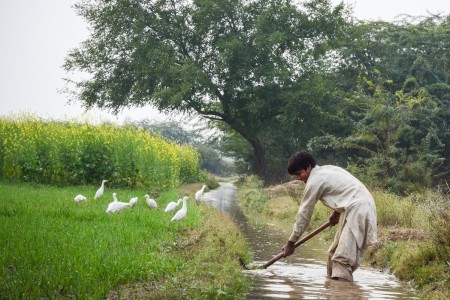
Can innovative policies and regulations reverse the trend of groundwater depletion? A three-year USAID-funded project implemented by IWMI, WLE and national partners across the Middle East-North Africa region investigated just that. Highlighted here are five problems that prevent the MENA region from properly addressing groundwater issues, as well as some potential solutions.
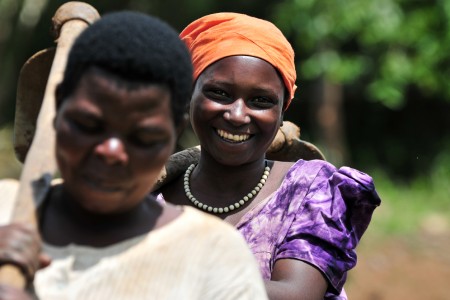
Ahead of the 11th International Conference on Community-Based Adaptation (CBA11), Daphne Nansambu looks at an aging agricultural population in Uganda and considers why so many youth are migrating away from farming, as well as what can be done to keep them in the sector.
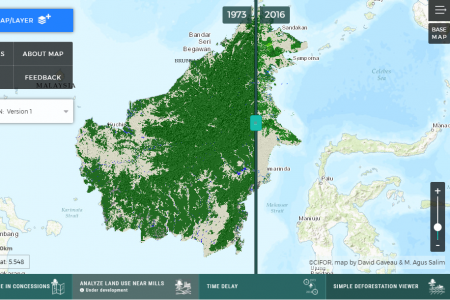
Almost 80 percent of the island of Borneo was covered with this old growth rainforest in 1973. Today, only 28 percent remains. A new Atlas of Deforestation and Industrial Plantations to map and reduce deforestation rates.
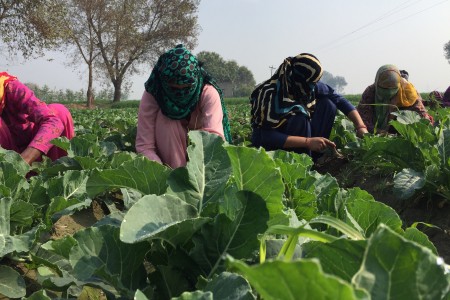
Providing crop insurance for smallholder farmers has been difficult in the past, leaving them vulnerable to floods, droughts, and other disasters. Now, satellite technology opens the door for insurance companies to provide affordable, timely coverage, reducing farmers' risks.
The Asia-Pacific Regional Assessment for the Intergovernmental Science-Policy Platform for Biodiversity and Ecosystem Services (IPBES) has been drafted and is ready for external review. Get involved!
This week marks the launch of the new CGIAR research portfolio. Izabella Koziell, Program Director, lays out the ambitions of the CGIAR Research Program on Water, Land and Ecosystems (WLE).
What changes need to take place in order to make agriculture socially, economically and environmentally sustainable while also being productive? What role does research play in bringing about this transformational change?
How can investors in climate resilience know whether their support is having the intended effect? In an attempt to provide answers, WLE scientists have reviewed a suite of existing tools designed to assess livelihood resilience in the face of climate change.
The WLE Focal Regions (2014-2016) were an ambitious attempt to apply the fundamental underpinnings of WLE at scale: sustainable intensification of agriculture and substantive investment in gender.
Sustainability is not necessarily everyone’s top priority. For many business leaders, cost, risk and reward are still the main drivers of decision making. But is it possible to reconcile business objectives and sustainability targets?
The disasters at Chernobyl and Fukushima have left vast areas of tainted, uninhabitable land. Their respective governments' drastically different approaches have had a range of consequences for wildlife, farming and the future of those two landscapes.