|
Managing
irrigation water for drinking & domestic use
Developing
country's efforts to supply drinking water to their rural communities
have focused primarily on digging deep tube wells and installing
hand-pumps to exploit groundwater, which is free from harmful bacteria
and parasites. But in large areas of South Asia, the Middle East
and East Africa, groundwater is not an option because of high arsenic,
fluoride, iron, or salt levels. Here irrigation water is often the
only water available for drinking, bathing, and washing.
Options
for improving drinking water quality in areas where groundwater
cannot be used have received very little attention. IWMI is trying
to put this issue on the map by looking at the ways irrigation water
can be made safer for human consumption.
IWMI
is conducting a series of studies in Pakistan, Sri Lanka and Morocco
that examine the links between irrigation management, domestic use
of irrigation water and human health. This research has highlighted
the need to bridge the gap between the irrigation and drinking water
supply sectors.
Currently,
the potential for exploiting the health benefits of irrigation water
is hindered by the lack of cooperation between drinking water providers
and irrigation planners and managers. A more coordinated effort
could improve water availability and quality. Especially if coupled
with hygiene education, this could result in a significant improvement
in community health.
 |
 |
|
Linkages
between Irrigation and Drinking Water in Pakistan IWMI
Working Paper 46. Available
on-line in PDF format, 792KB - requires Adobe
Acrobat Reader™.
Effect
of Chlorination of Drinking-water on Water Quality and Childhood
Diarrhoea in a Village in Pakistan. Available
on-line in PDF format, 155KB - requires Adobe
Acrobat Reader™.
Multiple
Uses of Water v in Irrigated Areas: A Case Study From Sri
Lanka. SWIM Paper 8. Available on-line
in PDF format, 362KB - requires Adobe
Acrobat Reader™.
To order the print version: send your request and postal address
to iwmi.publications@cgiar.org.
Abstracts
available on Tropical Medicine & International Health
Website
Links
to Domestic transmission routes of pathogens: the problem
of in-house contamination of drinking water during storage
in developing countries
Peter Kjær Jensen, Jeroen H. J. Ensink,
Gayathri Jayasinghe, Wim van der Hoek, Sandy Cairncross &
Anders Dalsgaard
Irrigation
water as a source of drinking water: is safe use possible?
Wim van der Hoek, Flemmming Konradsen, Jeroen
H. J. Ensink, Muhammad Mudasser & Peter K. Jensen

|
 |
-
Managing
water as a basic human requirement, Sri Lanka
Evaluating
the impacts of different water management decisions on
the quality and availability of water for drinking and
domestic use. more information>>
- Domestic
water supply and sanitation in irrigated areas, Pakistan
Maximizing
potential health benefits to be gained from the availability
of irrigation water for drinking and domestic use in areas
with brackish groundwater conditions. More
information>>
- Water
management for agricultural and domestic use, Morocco
Documenting
the benefits of managing water for both irrigation and domestic
use and developing ways of minimizing concomitant health
risks. More information>>
- Multiple
uses of irrigation water, Sri Lanka & Pakistan
Evaluating
the multiple nonagricultural uses and users of irrigation
water. More information>>
|
 |
|

WELL
is an on-line information resource center promoting environmental
health and well-being in developing and transitional countries.
The WELL site offers access to technical briefs, reports and
other publications as well as information on immediate technical
assistance services—provided to British and Southern
NGOs working in the water and sanitation sector in developing
countries.
The site is a collaboration between Water, Engineering and
Development Centre (WEDC) at Loughborough University and the
London School of Hygiene and Tropical Medicine with support
from Department for International Development (DFID).

|
|
|
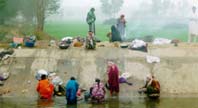 |
| Women
washing clothes in an irrigation canal, Pakistan. |
|
How
important are nonagricultural uses of irrigation water
for rural/agricultural development?
How
can the needs of nonagricultural users of irrigation
water be incorporated into the management and design
of irrigation systems?
How
can irrigation water be made safer for drinking, bathing
and washing?
What
is the impact of irrigation management on the availability
of fresh groundwater?
What
are the positive and negative health impacts of domestic
use of irrigation water?
How
can the health hazards of this practice—such as,
exposure to the parasite which causes schistosomiasis
(carried by water snails) when washing clothes or bathing
in irrigation canals—be reduced?
|
|
![]() |
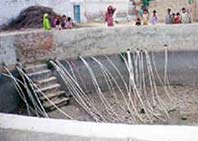 |
| In
Pakistan irrigation water is diverted to community reservoirs,
called diggis. The water is either hand carried or pumped
through PVC pipes to households. |
![]() |
 |
|

|
|
Irrigation
water that seeps from unlined canals, reservoirs
and fields often percolates through the soil layer
to form shallow pockets of groundwater.
These
provide a clean source of drinking water in areas
where groundwater is otherwise not potable. This
important indirect use is often not recognized
by authorities responsible for irrigation planning.
Interventions
designed to 'save' water, such as canal lining,
can leave village wells high and dry.
|
|
|
![]() |
|


