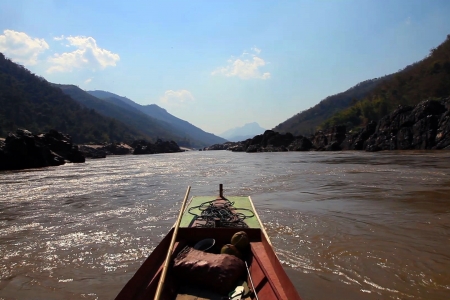
Laos’ rivers sustain millions of people as sources of food and water; they also provide some of Laos’ most popular tourist attractions. Policy makers in the Nam Xong river basin are getting a clearer understanding of how potential directions and decisions could affect the future of their region thanks to a modelling project sponsored by WLE.
While WLE researchers face a variety of challenges collecting data and meeting objectives across the Greater Mekong region, the stakes are arguably highest for the partners involved in the ‘Working together for a better Kachin landscape’ project in northern Myanmar. Here, armed conflict is still common and the threat of continued fighting makes the target of equitable development an imperative.
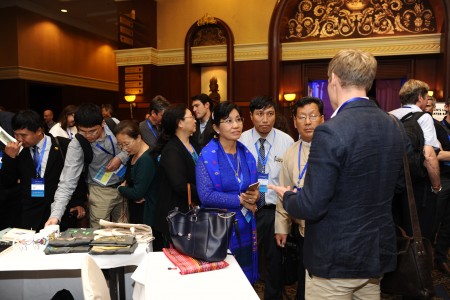
In 2015, China initiated the Lancang-Mekong Cooperation Mechanism (LMC). One year later, at the 2016 Greater Mekong Forum, LMC insiders reflected on what the LMC has accomplished, and how to move beyond the political aspects of the mechanism to focus on water issues and environmental questions.
Agriculture can be a means to landscape restoration, but this capability is often overlooked. A recent session at COP22 in Morocco begins to explore the ways that agricultural landscape restoration can play an integral role in mitigating climate change.
If you want to get into science blogging but you're not sure where to start, this post can help you find a potential focus. Whether you're a researcher, a development professional or a farmer, you likely have something to contribute to Thrive.
The intensification of agriculture has had devastating environmental consequences; however, as the earth's population increases, productivity must increase as well. As a recent WLE-funded paper argues, agroecological intensification (AEI) provides a promising way forward for both agricultural productivity and ecosystem health.
Building a dam can provide tremendous amounts of energy and desperately-needed water for agriculture; at the same time, dams have significant impacts on ecosystems and livelihoods. A new tool from SERVIR-Mekong can help decision-makers understand the impacts of dam construction.
Smallholder farms and large industrial farms are equally damaging to their ecosystems if they are monocropped. That said, shifting away form monocropping isn't only beneficial for ecosystems: it has economic rewards as well.
As human activity pushes our planet past its natural boundaries, the window for reversing environmental damage is rapidly closing. However, by modifying some human activities, especially agriculture, it might be possible to undo some of the damage that we have already done.
Smallholder farmers are both men and women; in many regions, women farmers increasingly make up the majority. Despite the many institutional, social, and economic barriers faced by rural women, they have the potential to change agriculture to be more climate adaptive.
In June, WLE-Mekong published a series of maps identifying a massive range of dams across the major rivers of the Greater Mekong Subregion. In this interview excerpt, the second in a series of two, Thrive discusses how strong partnerships led to the creation of these maps and continues to identify hot spots and spaces for new research.
The Salween is richly biodiverse and straddles several international borders; as of yet, it is Asia's last un-dammed river. The pressures of globalization and the promise of economic growth have made damming the Salween an attractive option to some, but such a decision would have wide-reaching consequences.