
Most people don’t realize there are two Noahs in the bible. There’s the man with the animals and the ark, and then there’s the woman who fought for equitable property ownership rights for men and for women. One of five daughters in a family with no male heirs, Noah and her sisters appealed to Moses, and even to God, for women’s inalienable and legal right to control their own land, with or without male co-ownership. This Noah is my namesake.
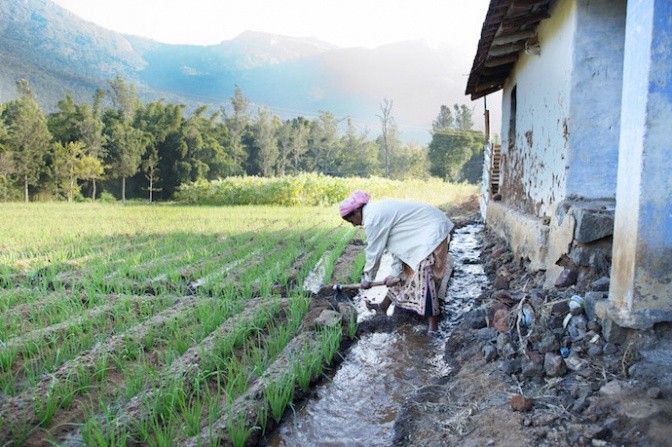 Including women in water management systems not only increases agricultural production, but is also vital to achieving the SDGs. Photo: Hamish John Appleby/IWMI
Mind the Gap
While biblical Noah and her sisters made enormous steps toward gender equity in agriculture, we still have a long way to go. The CGIAR Research Program on Water, Land and Ecosystems (WLE) and the International Water Management Institute’s (IWMI) recent publication, On Target for People and Planet: Setting and Achieving Water-Related Sustainable Development Goals, examines this issue in a chapter entitled “Social Inclusion”.
This chapter illustrates the idea that including women and the poor in water management systems not only increases agricultural production, but is also vital to achieving the Sustainable Development Goals (SDGs) on health, livelihoods, and economic growth. Equitable water access thus refers to both access and future management of water resources by these groups. Calling on governments, development agencies, and the private sector, WLE/IWMI recognizes that previous interventions classified as “gender-neutral” were in fact gender-blind, and did little to close the gender gap.
Social Inclusion for Productivity
IWMI’s research has proven that the proactive inclusion of women in water management decisions serves only to increase agricultural productivity. In their water usage, women are often segregated to access solely for domestic purposes. It is of critical importance to move beyond the stereotype of women as consumers in the private sphere, and to move to a paradigm of economic empowerment through access to productive water use.
This will be one of the ways to ensure the success of the SDGs for all members of a community. Provided that women have equal access to resources and human capital, women are as efficient agricultural irrigators as men. The potential alternative income opportunities related to water management reduce women’s vulnerability to exploitation, and contribute to economic empowerment of women.
Constraints to Water Access
Restrictions to equitable water access intersect with issues of land water ownership, social norms, class, and cultural practices, and are further compounded by social and institutional structures, thus leading to inequitable benefits derived from irrigation investment. WLE/IWMI recommends a wide-ranging approach predicated upon a reformulation of institutional policies and structural changes that addresses the intersecting nature of the marginalized groups.
For example, this chapter suggests interventions in collective management of land and water resources that allow both women and farmers to work together to achieve economies of scale. By challenging current exclusionary systems to allow women fair and affordable access to water resources, adequate and just reforms can be instituted that incentivize the inclusion of women and farmers in institutional water planning.
A major challenge to equitable water access lies in the common belief that water use is delineated by socially-defined gender norms, namely that women use water resources only in the domestic sphere. However, the lived experience of water use is quite different -- both men and women need access to water for domestic use and for income-generation.
In order to be sustainable, interventions need to be designed for multiple uses and must ensure that trade-offs do not marginalize particular social groups. Therefore, governments and policy makers should design efficient interventions that provide a high return per land unit, ensure the transmission of information and training to male and female farmers, and encourage all water services to be both multi-use and sustainable for all stakeholder farmers.
To counteract previous policies and strategies that have marginalized women and poor farmers, governments will have to invest significantly in innovative and equitable water interventions. WLE/IWMI proposes a series of four strategies and solutions to address these new actions, namely:
- Train policy makers, water planners and those in water organizations to actively understand and consider women’s and poor farmers’ needs for water
- Build the capacity of women and marginalized socio-economic groups so that they have more active decision-making and leadership roles in water management systems, at both the household and community levels
- Develop specific technologies and inclusive institutions and policies so women and poor farmers can participate in water use and management systems in the context of prevailing gender norms and local realities
- Improve women’s access and rights to water, through informal channels and legal mechanisms
This chapter addresses present challenges to equitable water access and proposes a paradigm shift that challenges exclusionary policy, both individually and structurally, and that brings women and poor farmers from the margins of society to the forefront of policy.
How do you think marginalized farmers can be appropriately integrated in water management strategies? What does that look like on an individual or a structural level?
Resources:
Ahlers, R.; Zwarteveen, M.Z. 2009. The water question in feminism: Water control and gender inequities in a neo-liberal era. Gender, Place and Culture 16(4): 409-426.
Harris, L. 2009. Gender and emergent water governance: Comparative overview of neoliberalized natures and gender dimensions of privatization, devolution and marketization. Gender, Place and Culture 16(4): 387-408.
Download the book:
Setting and Achieving Water-Related Sustainable Development Goals
Related contents

Blog Post 

Blog Post 


Related publications
Annual report 2021: CGIAR Research Program on Water, Land and Ecosystems
CGIAR Research Program on Water, Land and Ecosystems (WLE). 2022. CGIAR Research Program on Water, Land and Ecosystems 2021 Annual Report: Connected Thinking, Compelling Solutions. Colombo, Sri Lanka: CGIAR Research Program on Water, Land and Ecosystems (WLE). 79p.
Reflections on a decade of innovative research-for-development
CGIAR Research Program on Water, Land and Ecosystems (WLE). 2022. Reflections on a decade of innovative research-for-development. Colombo, Sri Lanka:International Water Management Institute (IWMI).CGIAR Research Program on Water, Land and Ecosystems (WLE). 12p. [LEGACY BRIEF 3].Restoring degraded landscapes. A synthesis of evidence generated by the CGIAR Research Program on Water, Land and Ecosystems (WLE) to influence planning, investments, research, practice, capacity and policy
CGIAR Research Program on Water, Land and Ecosystems (WLE). 2021. Restoring degraded landscapes. A synthesis of evidence generated by the CGIAR Research Program on Water, Land and Ecosystems (WLE) to influence planning, investments, research, practice, capacity and policy. Colombo, Sri Lanka: CGIAR Research Program on Water, Land and Ecosystems (WLE). 8p. [LEGACY BRIEF 1].Women’s work is never done: Lifting the gendered burden of firewood collection and household energy use in Kenya
Njenga, M.; Gitau, J.K.; Mendum, R. 2021. Women’s work is never done: Lifting the gendered burden of firewood collection and household energy use in Kenya. Energy Research & Social Science. 77:102071. https://doi.org/10.1016/j.erss.2021.102071A gendered analysis of shifts in adaptive water management in the Nile Delta of Egypt
Dessalegn, B.; Abd-Allah, E.; Salem, S. A.;Swelam, A. 2021. A gendered analysis of shifts in adaptive water management in the Nile Delta of Egypt. Egypt: International Center for Agricultural Research in the Dry Areas (ICARDA).
Comments
I am really impressed with your field of endeavor and your writing of the place of women in the advancement of the use of resources.